
Part One: Introduction
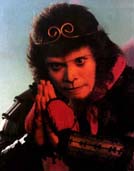
Stephen Chow in
A Chinese Odyssey 2
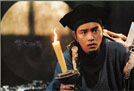
Leslie Cheung in
Chinese Ghost Story
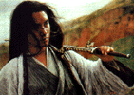
Leslie Cheung in
Ashes of Time
Ekin Cheng/Aaron Kwok
in The Storm Riders
If you've read a few Hong Kong film reviews or similar material you've probably encountered the term wuxia. The explanation offered of wuxia in such a context is usually along the lines of "flying swordsmen flicks". That's a very modern interpretation specific to HK films and doesn't reflect the depth or history of wuxia.
Wuxia has a rough literal translation as martial knight/adventurer (wu is things pertaining to warfare and xia are a form of chivalric person). Hence wuxia fiction might translate as tales of martial adventure or chivalry. That's only scratching the surface though; search the web for a more detailed explanation of the meaning, history and character of wuxia. (See Eric Yin's article "A definition of wuxia and xia" for more on the subject.)
Key-traits of the characters in wuxia fiction are generosity honour, martial prowess, honesty, sense of duty, sense of justice, and courage. These are the characteristics of a hero regardless of time-frame: they're just as important for the cops and triad members of modern fiction as for the sword-wielders of period pieces. Not only do these traits drive much of the action found in HK films, they also drive much of the drama: loyalty to a corrupt boss or a friend?, honesty even when it might cause personal harm?; you can no doubt recall dozens of such dilemmas from the films you have seen.
The good news is that wuxia fiction is an old, but still living art form. The earliest work can be traced back over 2,000 years, and while HK cinema is the most well-known modern source to most westerners there are still exponents of the written work. Indeed, it went through a true renaissance period in the second half of the twentieth century.
If you can read Chinese characters you're in for a feast. But if you're just limited to English don't despair. Many of the great classics are available in translated form and there is a sporadic trickle of more appearing from time to time. Indeed, some of the best works can be found for free on the internet!
Part Two: Classics
While there has been a great resurgence in wuxia literature in the last 50 years, some of the most famous and best is centuries old, having fired and enriched the imagination of scores of generations.
Numbered amongst the list of all-time classics of Chinese literature are three works that are undoubtedly wuxia. These are Romance of Three Kingdoms, Outlaws of the Marsh and Journey to the West.
Romance of Three Kingdoms
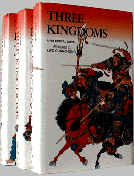
Romance of Three Kingdoms
Moss Roberts trans.
Image from China Guide.
Romance of Three Kingdoms is a historic-fictional account of the Three Kingdoms Period: 168-265 A.D. An epic in the true sense of the word it tells the tale of the warfare, intrigue, and conflict in which the three states (Wei, U, Su) of the time battle for preeminence and control of a unified China.
A huge work weighing in at over 750,000 characters it was originally a set of word-of-mouth stories passed down by performers before being collected together by Luo Guan Zhong in the fourteenth century. The huge cast of the story are the generals, statesmen and warlords from the period. The Confucian and wuxia themes of honour, loyalty, justice and self-sacrifice drive the characters and play out against the back-drop of the titanic battles.
An excellent free online translation of Romance of Three Kingdoms is available. The site features a downloadable version, individual chapters, supporting material such as essays on the work and history of the time, even an audio version. There are also two different translations available in book form (the online version is based on the Brewitt-Taylor translation). One peculiarity is that the default version has Latin (western) names substituted for all characters and places! Be sure to read the Pinyin version which uses the original names.
Outlaws of the Marsh
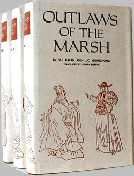
Outlaws of the Marsh
Shapiro translation.
Image from China Guide.
Outlaws of the Marsh, also variously known as Tales of the Water Margin and All Men are Brothers is another acknowledged classic. Written in the fourteenth century by Shi Nai'an and Luo Guan Zhong and set in the final years of Emperor Hui Zhong's reign (Song Dynasty, 1101-1125) it tells the tale of 108 virtuous men and women who became "bandits", chiefly due to oppression and corrupt officials. Another huge work with larger than life characters where the themes of fraternity, honour, justice, prowess and hospitality act as drivers. The work is available in a couple of different translations and also has been the inspiration for a TV series and a roleplaying game.
I have the Shapiro translation (pictured), a 3-volume set available from Foreign Language Press in Beijing with an ISBN of 7-119-01662-8. I recommend it. There are other versions, including a graphic novel (manga). China Books in Melbourne (mail order available) has a number of the alternate versions.
Journey to the West
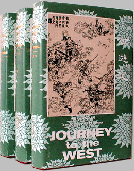
Journey to the West
Jenner translation
Image from China Guide.
Journey to the West is well known in Australia due to the 1979-81 Japanese TV series by the name of Monkey (shown on the ABC). The original story was written in the sixteenth century by Wu Ch'eng-en and is also numbered amongst the literacy classics of China. It tells the story of a Buddhist priest's journey from China to India to obtain sacred scriptures (Tripitaka- the same name as the priest bears). Tripitaka is accompanied on his journey by three special disciples: supernatural animal spirits. The most famous and senior of these is Monkey (also known as Aware of Vacuity and Great Sage Equal of Heaven), an immortal monkey spirit who is the archetype prankster of Chinese mythology (easily equalling Loki or Coyote in my opinion). The priest and his disciples are beset by many obstacles on their way; usually by demons and other spirits who wish to thwart their mission.
While the tone of Journey to the West is somewhat more supernatural legend than the previous two the recurring themes of brotherhood, duty and honour are strong motivators for the characters of Tripitaka and Monkey. The full story is long and divided into many chapters, each of which describe an obstacle encountered.
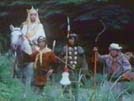
Monkey TV series.
Image from Monkey! site
The Japanese TV version starring Masaaki Sakai as Monkey does quite a decent job of telling parts of the story though adding unique elements of Japanese comedy and Chanbarra action. There is a fantastic site dedicated to this series (of related interest, Siren Visual Entertainment in Australia has released the series in 13 3-episode instalments on Zone 4 DVD and PAL VHS video. Fabulous Films in the UK has also released the whole series on PAL VHS video).
Hong Kong comedian Stephen Chow also gives a remarkable interpretation of the furry trickster in Jeff Lau's two-part film about the reincarnation of Monkey, entitled A Chinese Odyssey 1: Pandora's Box and A Chinese Odyssey II: Cinderella (1995).
There are many translations of the original Journey to the West story available ranging from children's books through to complete translations of the entire work. The most easily found of these is the Arthur Waley translation going by the name of Monkey and available as a paperback from Unwin (there is said to be a 2nd revised edition coming out shortly). This is a greatly abridged version of the story. A search on the web will likely turn up a number of interesting resources.
Strange Tales
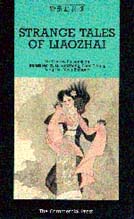
Strange Tales of Liaozhai
On the theme of the supernatural there are a wide range of folktales and legends available in translation, often as collections. Some of these definitely cross over into the wuxia genre. For instance Pu Songling's stories served as the inspiration for both Ching Siu Tung's Chinese Ghost Story (1987) and King Hu's Painted Skin (1992). These stories are available as a number of translated collections: Strange Tales from the Lianoxhai Studio or Strange Tales from the Make-Do Studio. These, and a comic/manga version are all available from China Books. Similarly, searches on the web for Chinese fairytales, myths, legends and folktales will turn up a number of stories.
Part Three: Modern Sources
Not all wuxia fiction is hundreds of years old. Indeed the twentieth century saw a renaissance in the wuxia genre with novels even being serialised daily in Taiwanese newspapers. It is said that over 4,000 wuxia novels have been written in the last century.
Jin Yong
One author of this era: Jin Yong (Louis Cha), stands above all others. His works, all written between 1955 and 1972, are a by-word for wuxia in Chinese communities across the globe.
Dozens of HK films are directly based on or inspired by Jin Yong stories, with a particular craze for wuxia films in the early 1990s, e.g. Tsui Hark's Swordsman series (1990 - 1993), Cheung Hoi-ching's Sword Stained with Royal Blood (1993) and Wong Jing's films Kung Fu Cult Master (1993) and Royal Tramp I & II (1992). Perhaps the most beguiling adaption is Wong Kar-wai's Ashes of Time (1994), although it is almost universally hated by Jin Yong fans! There have also been many long-running television series based on his works, but unlike the films these are unfortunately not subtitled in English.
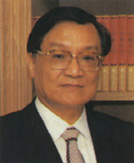
Jin Yong (Louis Cha)
Image from AsiaPac Books.
The stories themselves are filled with secret societies, honour, betrayal, special styles of kung fu, hospitality, love, revenge and duty. Just as the classics of old they are large works and set against a meticulously researched historic background.
While it is possible to catch a glimpse of the quality of these works through the filter of a HK film, no single (or series of) film(s) can do justice to the grandeur or intricacy of one of Jin Yong's works. Fortunately, a small selection of the stories have been translated into English.
Jin Yong Translations Online
For a quick taste of Jin Yong, the story Sword of the Yueh Maiden is available online. The only short wuxia that Jin Yong ever wrote it is also said to be his poorest, lacking the depth and richness of his other work. Perhaps so, but it is still a great read. Set in the 5th century BC it tells the story of the Yueh kingdom's quest for sharp swords and unbeatable sword techniques; finding the later in a young shepherdess' wielding of her staff. The story appears to move about on the web a bit; as of the time of writing, you can find it here. (There are a couple of possible reasons why Jin Yong material can be hard to find on the web. One is that students often like to put his stories on their page, but when they leave campus, the page expires. Another factor is the takedown notice on the Jin Yong Links page: dated March 1998, it is a letter from the author's lawyers to any websites hosting unauthorised versions of his copyrighted material.)
A more representative and fully authorised work is Graham Earnshaw's terrific translation of The Book and the Sword. This is the first novel that Jin Yong wrote and is set during the reign of the Manchu emperor Qian Long (during the mid eighteenth century). The story concerns the key members of the Red Flower secret society, a brotherhood sworn to the overthrow of the Manchu dynasty. Once again the typical wuxia and Confucian themes combine for a fantastic story. If you're considering just reading one wuxia story then try this, you won't be disappointed.
Many fans are now generously translating Jin Yong's works. Moinllieon's novel translations site has translations in progress for Eagle Shooting Heroes and Demi-Gods and Semi-Devils. Lanny has finished State of Divinity (aka The Smiling Wanderer) Noone is working on Hap Hak Hang. Amanda keeps tabs on all of these at her site Jin Yong Novels Online.
Jin Yong Translations in Print
I'm aware of three printed translations of Jin Yong's work:
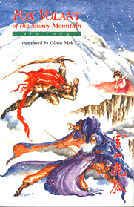
Fox Volant
Olivia Mok trans.
Image from Eastwind
Fox Volant of the Snowy Mountain is a translation by Olivia Mok available from Chinese University Press (ISBN 9622025263). I don't have a copy but understand that it's a love tragedy centering on Hu Fei, the hero (Flying Fox) of the title. Reviews by others who have read it are mixed, saying it is a decent read but pricey and that perhaps the translator lacked sufficient knowledge of martial arts and its terminology.
His last (and also often regarded as best) work is The Deer and the Cauldron. Two of the three volumes have been translated by John Minford and are available from Oxford University Press as hardbacks (ISBN 01949031234 and 0195903250). Interestingly, while a wuxia novel complete with lots of martial arts action, the main character Wei Hsiao Bao is not a martial-artist, having more of the character of a charming con-man. The Royal Tramp films (1992) starring Stephen Chow are loosely based on this story. Be warned that each volume of The Deer and the Cauldron weighs in at $80 and takes three to four months to arrive from the Hong Kong presses. If you want to sample before buying then look for Volume 3 (June 1993) of The Journal of East Asia History in your university library: it has 2 chapters of Minford's translation.
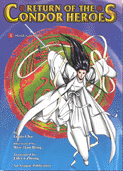
Return of the Condor Heroes
Image from AsiaPac Books.
The final English Jin Yong resource I'm aware of is the comic/manga series Return of the Condor Heroes (Shendiao) published by AsiaPac Books of Singapore. A translation of the second volume (Condor and the Xia Lovers? or The Condor and its Companion) of the Shen Diao trilogy it comes as 18-volumes. The artwork by Wee Tian Beng is quite high quality and the translation is said to be decent. The story takes places during the Mongol invasion and downfall of the Song dynasty with a backdrop of the wulin's (martial arts community) response to the invasion. However the real focus of the story is the love between Yang Kuo and his teacher. AsiaPac are on the web and you can view some of the artwork. China Books in Melbourne stocks this title.
Part Four: Additional Modern Sources
In addition to Jin Wong, there are stories, novels and comics by other authors available in English.
Huan Zhu Lou Zhu

Blades from the Willows
Robert Chard trans.
Image from WellSweep
Blades from the Willows is available from Wellsweep Press (UK) and is a story of taoist immortals, flying swordsmen (and women) and strange beasts as three friends visit an old recluse on his mountain. The first book in a trilogy entitled The Swordsmen's Haven at Willow Lake, it is written by Huan Zhu Lou Zhu and translated by Robert Chard (a scholar of the wuxia genre). Huanzhulouzhu was the pen-name of Li Shanji (1902-1961), one of the most popular wuxia authors of pre-revolution China. I believe the second book is out but I have yet to see it. Basically, it does not have the quality of a Jin Yong story and is at quite a different power level (everyone besides the main protagonists seem to be immortal flying warriors or sorcerers), but a good read none-the-less.
Robert Van Gulik
Robert Van Gulik (1910-1967) wrote a series of stories about his character Judge Dee. Van Gulik was a Dutch diplomat and authority on China, and based Dee on the famous historical figure Dee Jen Djieh who lived in the seventh century and is best known for his detective-style work while a magistrate.
The stories draw on the seventeenth century Chinese detective stories for format and inspiration and typically consist of Dee solving strange and peculiar cases.
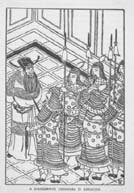
Judge Dee woodcut
Image from Christian Weinert
The stories are rich and intriguing and well worth a look, though not directly wuxia, being more of the historic detective genre. However Dee has a number of lieutenants who serve as his eyes and arms and who get fair spotlight time in most stories. These lieutenants range from clerks to reformed gamblers and members of the fighting fraternity (martial artists). Clashes with criminals and the underworld are not uncommon and the character drivers for these lieutenants are classic wuxia. Colin Glassey's website on Robert Van Gulik has good background on the author and the series.
The University of Chicago Press produces sixteen Judge Dee titles by Van Gulik with such names as The Chinese Bell Murders, Judge Dee at Work, The Chinese Maze Murders and Murder in Canton. The Judge Dee series was apparently quite popular several decades ago and many public libraries seem to have a copy of one or more of the titles. Hence, for a first look and taste check out your local library rather than ordering one sight-unseen (if you are feeling game, do a "Judge Dee" search on Amazon).
Manga
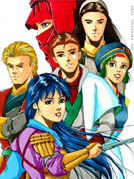
Celestial Zone
Image from AsiaPac Books.
Not surprisingly wuxia material has been found in the comic/manga world (and anime too, but that's another article). As mentioned earlier there is Return of the Condor Heroes from AsiaPac Books, a translation of a Jin Yong work. They also have another series called Celestial Zone by Wee Tian Beng, based on the interaction between Chinese martial artists and denizens of the underworld.
During the 1980s Jademan Comics translated a number of excellent Chinese comic series into English with such titles as Force of Buddha's Palm, Drunken Fist, Iron Marshal and Blood Sword Dynasty. I also understand that a couple of newer Jademan titles have recently been translated and released through Image, though the genre is martial arts plus science fiction.
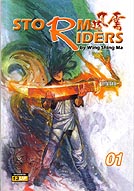
Storm Riders
Films based on Chinese swordplay comics are currently enjoying a resurgence in Hong Kong cinema, with Andrew Lau's blockbuster fantasy hits The Storm Riders (1998) and A Man Called Hero (1999) both based on long-running series of Ma Wing Shing.
Storm Riders is now appearing in English translation from the US publisher Comics One; you can download a preview from their website. This publisher is establishing itself as the new force in English-language kung fu comics, with many adaptations from Louis Cha (Jin Yong) as well as some original Jademan series, Crouching Tiger Hidden Dragon, and more.
Part Five: Getting Started
So, while there isn't a wealth of material out there, there are sources to pick between. Where to start?
I suggest trying to track down online versions of Jin Yong's work as a jump-off point. The short Sword of the Yueh Maiden as a quick introduction followed by the much longer (and better) story The Book and the Sword.
From there choices open up: go for a free classic with the online Romance of Three Kingdoms, search for some Judge Dee (Van Gulik) at your local library or start building up a library of your own: order some Jin Yong or go for the visual extravagance (one of the reasons we love Hong Kong cinema) of manga such as Condor Heroes or Celestial Zone.
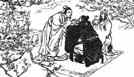
A famous scene from the start of Romance of Three Kingdoms: three heroes swear brotherhood in the peach garden.
Image taken from the Three Kingdoms site
For your browsing convenience, here is a list of all of the websites cited in the article.
Resources
- Martial Arts Novels: a fine collection of wuxia links from About.com.
- Romance of Three Kingdoms: excellent online translation of this wuxia classic.
- Outlaws of the Marsh roleplaying game: an RPG set in the Water Margins.
- The Book & the Sword: a Jin Yong story translated by Graham Earnshaw.
- Sword of the Yueh Maiden: a Jin Yong story.
- Novel Translations: Moinllieon is translating Jin Yong & Gu Long novels.
- State of Divinity: Jin Yong novel translated by Lanny.
- Jin Yong Novels Online: Amanda's site has Noone's translation of Hap Hak Hang
- spcnet: solid site about wuxia television series and novel translations.
- Eric Yin's article "A definition of wuxia and xia": an excellent introduction.
- Jin Yong links page: an astounding collection of links to Jin Yong fan pages.
- Colin Glassey on Robert Van Gulik: an article about the Judge Dee mysteries.
- Christian Weinert's Judge Dee page: splendid site and web ring about Judge Dee.
- Monkey!: wonderful site about the classic Japanese television series.
- Wang Du Lu's novels: the Crouching Tiger novels summarised by Jane.
Publishers
- Wellsweep Press: UK publishers of Huanzhulouzhu's Blades of the Willows.
- AsiaPac Books: Singaporean publishers of wuxia comic adaptations
- Comics One: new US publishers of Storm Riders and many other comics.
- Flying Swordsman: wuxia fanzine debuting in 2004, submissions wanted!
Mail Order
- China Books: fine Melbourne bookstore, wuxia-friendly. Mail order is available.
- China Guide: US mail order stockist has plenty of wuxia books.
- Eastwind: US mail order firm. Carries Jin Yong's Fox Valant novel.
- Amazon: you can order Judge Dee books from this US online uber-bookstore.
ABOUT SPIKE
Father of two, and academic looney, SPIKE has carried his nickname from childhood: across state lines and into Asia and back. Lecturing in computer
science, Spike's research involves speech recognition and virtual reality. A student of Japanese & Chinese martial arts his love of action cinema started
way back with the old black-n-white Shintaro series (a dubbed Japanese Chanbara) and has grown from there.